Migration Case Study
After VMware: Operating the Hybrid Environment That Comes Next
How AAIC connected phased VMware migration to hybrid operations, SRE ownership, recovery planning, and OpsRabbit-assisted investigation with engineer review.
Mid-Market Enterprise · Customer name withheld for confidentiality.
Customer Context
A mid-market enterprise moved selected VMware workloads to AWS while retaining systems that supported local integrations and constrained applications. The transition created a hybrid estate: cloud services depended on on-premises identity, private connectivity, scheduled jobs, and shared data flows. The customer remains anonymous for confidentiality.
The buyer’s concern was ownership. A successful cutover is insufficient if the next incident falls between the migration team, infrastructure administrators, application owners, and service providers. AAIC connected the migration plan to an operating model covering stabilization and routine operations.
Establish Ownership Before Migration
AAIC’s approach mapped each business service to application and infrastructure ownership, escalation, telemetry, recovery procedures, and change authority. Responsibility boundaries distinguished AWS responsibilities, customer decisions, AAIC execution, and third-party support. Retained VMware systems received named owners rather than becoming an exception queue.
The service register connected critical journeys, maintenance windows, dependencies, and recovery objectives. Monitoring priorities included transactions, replication, connectivity, certificates, backups, capacity, and scheduled processing. An alert needs a responsible responder and a usable runbook, not only a notification destination.
Phase the Operating Handover
Foundation work establishes identity federation, least-privilege roles, segmented access, audit trails, secrets handling, time synchronization, and infrastructure-as-code review. Teams test alert routing, access recovery, and backups before relying on those controls during a cutover.
The operating transition then follows three phases:
- Before each wave: record baselines, rehearse failure paths, confirm on-call availability, and review application dependencies with their owners.
- During cutover and stabilization: staff the change bridge, track acceptance evidence, preserve source recovery options, and review incidents against explicit exit criteria.
- After acceptance: transfer approved runbooks, unresolved risks, inventories, access records, and recovery evidence into routine service ownership.
Stabilization ends when business checks pass, alerting is actionable, restores are demonstrated, and outstanding risks have accountable owners. It does not end merely because a calendar interval has expired.
OpsRabbit Correlates Evidence; Engineers Decide
OpsRabbit provides the investigation-assistance layer across authorized alerts, logs, metrics, deployment records, infrastructure changes, and service context. Connector coverage and data quality define what evidence is available. Missing evidence remains a gap, not permission to invent a cause.
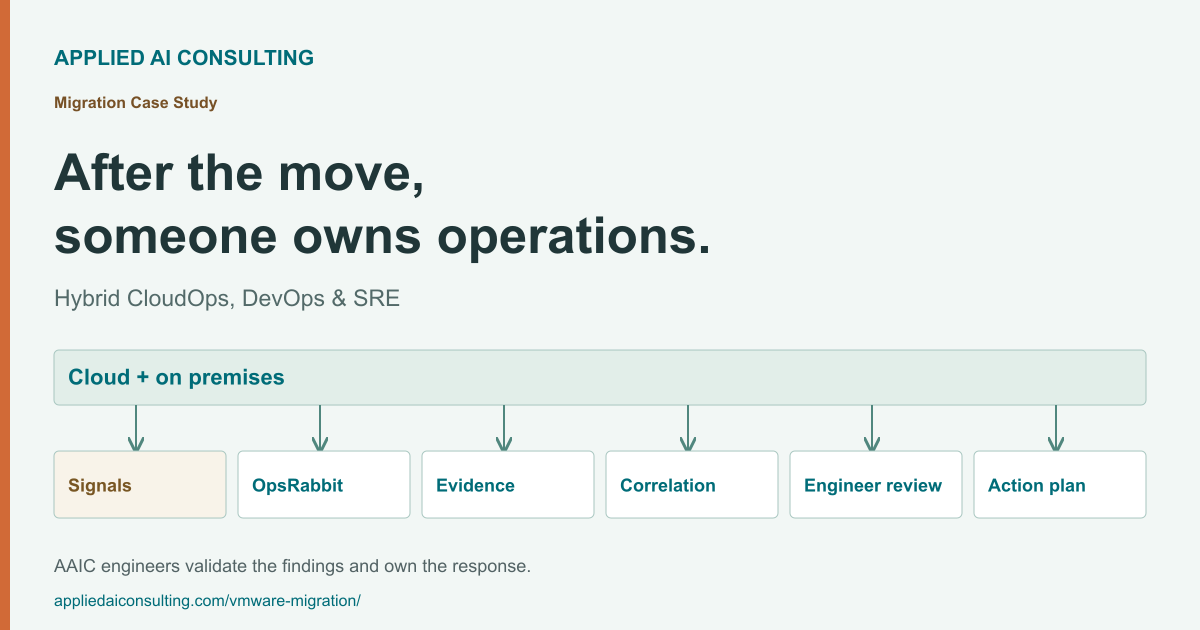
The incident path is deliberate: monitoring identifies a symptom, OpsRabbit assembles relevant evidence and possible explanations, and an AAIC SRE engineer checks timestamps, dependencies, change history, and contradictory signals. The engineer records a supported hypothesis, seeks approval where required, and executes an authorized runbook or escalates to the application owner.
OpsRabbit does not autonomously fix production, grant access, change routing, or decide that recovery is complete. Any approved operational automation remains separately governed. Evidence collection uses scoped access, audit logging, retention limits, and sensitive-data filtering; investigation access does not imply write permission.
- Evidence
- Correlation
- Likely root cause
- Recommended next action
Follow the investigation workflow
- Application latency: a monitoring alert identifies the affected service and time window.
- Infrastructure context: review available cloud, Kubernetes, and retained-system signals for that window.
- Change context: compare recent deployments, configuration changes, and relevant incident history.
- OpsRabbit assistance: correlate the accessible evidence, identify a likely cause, and outline the next checks. Missing evidence remains an explicit gap.
- Engineer decision: AAIC validates the findings and selects remediation, escalation, or further investigation. A correlation is not proof of causation.
Investigating Across the Hybrid Estate
Hybrid investigations need to connect application latency, database connections, private-link health, queue depth, and recent changes across platform boundaries. A routing change and a connection-pool adjustment can both appear relevant; correlation alone proves neither caused a failure.
The AAIC SRE engineer reviews the evidence, checks affected dependencies, and agrees the next action with the change owner. That can mean a reversible rollback, additional checks, or escalation to a specialist. Recovery is determined by service validation and business acceptance, not by an AI-generated explanation alone.
Cutover and Rollback Remain Controlled Changes
Every migration wave needs a change owner, acceptance criteria, replication checks, a rollback decision point, and a communications plan. The service desk and application owners should know which environment is authoritative throughout the change.
Rollback before target writes can restore the source traffic path. After writes begin, recovery requires validated reconciliation or a tested reverse-data procedure. Teams must prevent two independent writable systems. The incident commander can stop a wave when data integrity, error rates, or the recovery window breaches agreed limits.
Source decommissioning follows acceptance, retention checks, and confirmed recovery readiness. Leaving the source running indefinitely is not a rollback strategy; it adds cost, exposure, and ambiguity about ownership.
Disaster Recovery Across Both Environments
Recovery planning follows business services rather than platform boundaries. Application owners agree recovery-time and recovery-point objectives; engineers map those objectives to backups, replication, access, and restoration steps across AWS and VMware.
Recovery exercises cover isolated restores, dependency ordering, connectivity loss, failover, and failback where designed. Successful backup jobs do not demonstrate application recovery. Evidence includes recovered data checks, transaction tests, recovery timings, and unresolved gaps. Regional recovery is included only where explicitly designed, not assumed from cloud hosting.
Routine Day-2 Work and Buyer Acceptance
The recurring service model covers agreed patching, vulnerability triage, certificate renewal, capacity, backup verification, infrastructure drift, release support, and cost review. Spend is attributed across cloud and retained systems. Recommendations enter the same approval process as other production changes.
Service reviews examine incident trends, repeat problems, recovery exercises, open risks, and runbook quality. Coverage, response targets, and responsibilities follow the agreed service scope rather than an implied universal SLA.
The engagement connected migration acceptance to ongoing ownership: named responders, defined authority, evidence-backed investigation, recovery controls, and an explicit improvement backlog. AAIC’s SRE ownership and OpsRabbit’s investigation assistance remain distinct responsibilities.
More migration case studies
Your next infrastructure decision
Before Your Next VMware Decision, Know Your Options.
Understand what should stay, what should move, what should modernize, and what the resulting environment will cost and require to operate.