Migration Case Study
VMware Data Center to AWS: A Workload-by-Workload Migration Strategy
How AAIC assessed 186 VMware VMs for an industrial manufacturer, delivered six migration waves, and reduced three-year infrastructure TCO by 30%.
Industrial Manufacturing · Customer name withheld for confidentiality.
Customer Context
An industrial manufacturing organization approached an infrastructure renewal with 186 VMware virtual machines, 72 TB of data, and more than 40 applications. Order processing depended on warehouse interfaces, scheduled integrations, identity services, and plant connectivity. Moving every VM unchanged would preserve avoidable capacity; moving every application at once would concentrate production risk. The customer remains anonymous for confidentiality.
AAIC’s work connected a decision for each workload to an executable transition sequence and a cost comparison that included the systems remaining on premises.
Establish the Estate Before Choosing Destinations
Discovery reconciled virtualization inventory with utilization, storage growth, application ownership, licensing, backup coverage, and application dependencies. Maintenance windows, batch schedules, latency constraints, and unsupported software informed the decisions. Plant-facing dependencies remained explicit rather than disappearing from the cloud estimate.
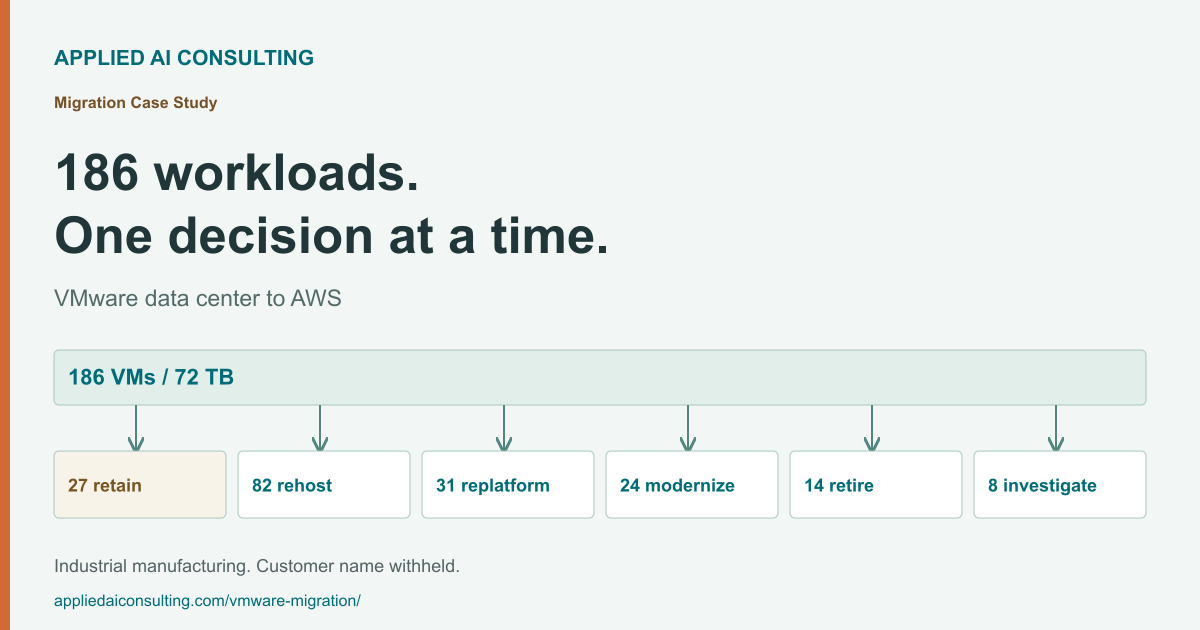
The disposition register assigned each VM once:
| Disposition | VMs | Planning decision |
|---|---|---|
| Rehost | 82 | Move compatible workloads to EC2 with limited application change. |
| Replatform | 31 | Adopt supported managed infrastructure after compatibility tests. |
| Modernize | 24 | Change application components where operational benefit justifies engineering. |
| Retain | 27 | Keep plant proximity, licensing, or unsupported dependencies on premises. |
| Retire | 14 | Remove only after owners confirm usage and retention obligations. |
| Investigate | 8 | Resolve ownership, dependencies, and destination before approval. |
| Total | 186 | No VM appears in two disposition groups. |
Within the 82 rehost candidates, 23 VMs were rightsized after utilization and performance validation. Those 23 are a subset, not additional workloads. VM counts are not application counts; the 72 TB required separate replication, retention, and transfer planning.
Before / centralized virtualization
VMware estate
Inventory, application dependencies, and ownership determine what happens next.
After / selective transformation
Right workload. Right environment.
Owner-approved retirement and operational acceptance complete the migration. AWS services shown are options, not a prescribed architecture.
Wave 0 and Six Controlled Workload Waves
Wave 0, Foundation, established inventory, dependency groups, ownership, and acceptance criteria alongside accounts, identity, network segmentation, connectivity, logging, budgets, backups, and infrastructure-as-code controls. Recovery and operational ownership were entry gates. This foundation phase preceded, and was outside, the six workload waves.
Six controlled workload waves follow that foundation:
- Pilot: Rehearse a low-risk application group, validating replication, monitoring, restore, rollback, and business acceptance.
- Low dependencies: Move independent internal services with known owners, checking latency and cost against assessment assumptions.
- Shared services: Migrate eligible shared services and file workloads after testing dependent applications against the new endpoints.
- Data services: Replatform compatible databases, reconcile data, verify recovery points, and test performance within an agreed rollback boundary.
- Business apps: Cut over business-critical groups within plant-approved windows, with application owners and an escalation team present.
- Acceptance: Complete remaining approved groups and service validation; decommission only after recovery, retention, and owner sign-off.
The six waves were sequencing groups, not equal VM batches. Dependencies determined membership; unresolved workloads stayed outside an approved wave. Retained systems remained managed dependencies. Retirement required evidence and approval, even when no AWS destination was needed.
Wave 0Foundation
Confirm inventory, dependency groups, ownership, target identity, network access, backup, security, and acceptance criteria. This preparation phase is outside the six workload waves.
Wave 1Pilot
Rehearse a low-risk application group. Validate data replication, monitoring, restore, rollback, and business acceptance before expanding.
Wave 2Low dependencies
Move independent internal services with known owners. Check latency and cost against the assessment assumptions.
Wave 3Shared services
Migrate eligible shared services and file workloads after dependent applications have been tested against the new endpoints.
Wave 4Data services
Replatform compatible databases. Reconcile data, verify recovery points, test performance, and use an agreed rollback boundary.
Wave 5Business apps
Cut over business-critical application groups within approved windows, with application owners and an escalation team present.
Wave 6Acceptance
Finish the remaining approved groups, validate the service, and decommission only after recovery, retention, and owner sign-off. Unresolved workloads stay in the investigation backlog.
Cutover, Rollback, and Recovery
Each wave has an owner-approved runbook, replication checks, a change freeze, acceptance tests, and a timed go/no-go decision. Tests cover orders, batch completion, identity, interfaces, and latency, not merely server availability.
Before writes move, rollback can return traffic to the source. After target-side writes begin, the runbook requires reconciliation or a tested reverse-data procedure before reopening the source. Independent writable copies are prohibited. The change lead triggers rollback when agreed error, reconciliation, or elapsed-time limits are exceeded.
Recovery objectives are agreed per business service. Backups, isolated restores, and a DR exercise must demonstrate recoverability across AWS and retained infrastructure. Replication alone is not proof of recovery.
Results: 30% Lower Three-Year Infrastructure TCO
The engagement achieved a 30% reduction in three-year infrastructure TCO. The workload decisions supported that result:
- 14 workloads retired: unnecessary systems were removed rather than migrated.
- 23 workloads rightsized: capacity was adjusted before cloud placement.
- 24 workloads selected for modernization: application change was targeted instead of applied to every VM.
- Six controlled workload waves: migration followed dependency groups and acceptance gates.
This is the result for this engagement, not a guaranteed saving for another estate. Customer-specific financial line items and commercial terms are not disclosed.
Day-2 Ownership and the Buyer Decision
AAIC’s operating model covers alerts, patching, recovery, capacity, and spending across cloud and retained infrastructure. OpsRabbit supports evidence correlation and investigation; engineers validate findings and approve changes.
The work brought inventory, workload decisions, migration runbooks, recovery planning, and Day-2 ownership into one delivery approach. The outcome was a smaller, more deliberately placed estate rather than an indiscriminate VM move.
More migration case studies
Your next infrastructure decision
Before Your Next VMware Decision, Know Your Options.
Understand what should stay, what should move, what should modernize, and what the resulting environment will cost and require to operate.