AI Operations
AI-Powered Managed DevOps & SRE for a Connected Device Platform
See how AAIC provides AI-assisted Managed DevOps and SRE for a connected device platform, using OpsRabbit to accelerate incident investigation, improve RCA quality, and support SLA-aligned operations.
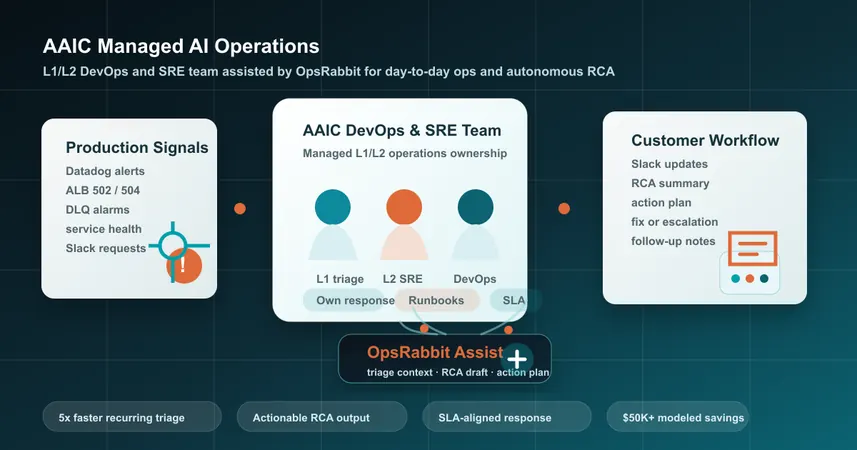
AI Operations Case Study
AAIC provides Managed DevOps and SRE support for an Austin-based connected device and IoT platform company operating cloud infrastructure that supports device communication, application services, and operational workflows.
As the platform scaled, the customer needed reliable production operations support for cloud operations, incident response, deployment reliability, and production issue investigation. AAIC delivers that support through a managed operating model strengthened by OpsRabbit, AAIC’s AI-assisted investigation accelerator.
Instead of treating alerts as isolated events, AAIC helps turn operational signals into structured investigations, action plans, and reliability improvements.
Managed AI Operations model Anonymous connected device platformCustomer Context
The customer operates a cloud-native connected device platform where device telemetry, APIs, backend services, queues, application load balancers, monitoring systems, deployment pipelines, and customer-facing workflows all need to work together.
When systems in this type of environment fail, the impact is not limited to infrastructure. It can affect device communication, field operations, application availability, support workflows, and customer trust.
AAIC supports the customer as an AI Operations partner, combining skilled DevOps and SRE engineers with OpsRabbit-powered investigation workflows.
The Challenge
The customer needed a more scalable way to manage production operations across a cloud-native connected device environment.
Key operational challenges included:
- Recurring production alerts from monitoring systems
- 502 and 504 errors from application load balancers
- Service responsiveness issues
- Dead-letter queue alarms
- Need for faster incident triage
- Need for clear action plans during incidents
- Dependency on experienced engineers for investigation
- Requirement to support production operations without overloading the core engineering team
The environment required more than basic monitoring. It needed active investigation, context-aware troubleshooting, and a reliable operational response model.
Operational Signals Managed by AAIC
AAIC’s Managed DevOps and SRE team supports operational workflows triggered by production signals such as:
- Datadog alerts
- Application load balancer 502 errors
- Application load balancer 504 errors
- Dead-letter queue alarms
- Service task health issues
- Application responsiveness issues
- Infrastructure and application anomalies
- Slack-based operational requests from the customer team
Examples of anonymized operational scenarios include repeated 502 errors from an application load balancer, elevated 504 responses from a private load balancer, dead-letter queue alarms affecting reservation workflows, and backend service health checks when the application was not responding.
No customer screenshots, Slack messages, alarm IDs, or timestamps are used in this case study.
The AAIC Solution
AAIC provides an AI-powered Managed DevOps and SRE operating model for the customer.
The model combines experienced DevOps and SRE engineers with OpsRabbit, AAIC’s AI-assisted operations platform. Together, the team supports:
- Alert investigation
- Incident triage
- Root cause analysis
- Operational action planning
- Cloud infrastructure support
- Service health validation
- Deployment and runtime issue investigation
- Slack-based collaboration with customer teams
OpsRabbit acts as an investigation accelerator by helping the team correlate operational context, structure investigation steps, and generate clear action plans.
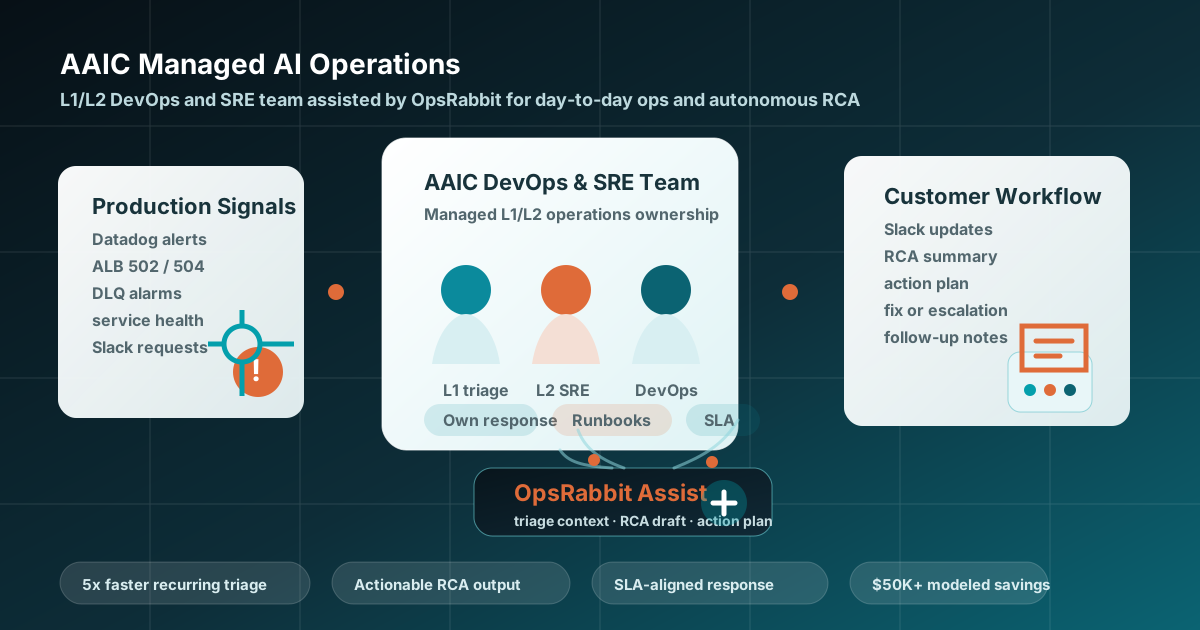
Powered by OpsRabbit
OpsRabbit is used as an AI-assisted investigation layer inside AAIC’s Managed DevOps and SRE workflow.
When an alert or operational issue is raised, OpsRabbit helps AAIC support teams:
- Understand the incident context
- Analyze alert details
- Review likely causes
- Suggest investigation steps
- Create a clear action plan
- Improve consistency of RCA communication
- Reduce repetitive manual investigation effort
The customer team interacts through Slack-based operational workflows, allowing investigations to begin from the same place where alerts and engineering collaboration already happen.
Managed DevOps & SRE Operating Model
AAIC supports the customer through a managed operational model designed for responsiveness, continuity, and repeatability.
Alert Intake
Production alerts from monitoring systems are reviewed and triaged.
AI-Assisted Investigation
OpsRabbit helps structure the investigation and identify likely causes based on alert context and operational signals.
Engineer Review
AAIC DevOps and SRE engineers validate findings, review system health, and decide the appropriate next step.
Action Plan
The team creates a clear plan with immediate checks, remediation options, and escalation path if required.
Customer Collaboration
Updates are shared through Slack-based workflows to keep customer engineering teams aligned.
Continuous Improvement
Recurring incidents and patterns are reviewed to improve operational reliability over time.
Example Incident Patterns Supported
Application Load Balancer 502 Errors
AAIC investigates elevated 502 responses, reviews backend service health, and identifies whether the issue is related to application tasks, upstream services, deployment changes, or infrastructure behavior.
Application Load Balancer 504 Errors
AAIC triages timeout-related issues where backend services may be slow, unavailable, overloaded, or unable to respond within expected thresholds.
Dead-Letter Queue Alarms
AAIC reviews queue-based failure patterns where messages are not processed successfully and identifies service logic, dependency, configuration, or processing delay issues.
Service Health and Task Availability
AAIC validates whether application service tasks are running correctly, responding as expected, and aligned with production configuration.
Slack-Based Operational Requests
Customer teams can initiate investigation requests directly from Slack, reducing friction between alert detection and operational response.
RCA and Follow-up Notes
Investigations are converted into clearer summaries with likely cause, evidence, action plan, and escalation or follow-up notes.
Results and Impact
The engagement helped the customer create a more structured, AI-assisted operating model for DevOps and SRE support.
Up to 5x Faster Triage
For recurring alert patterns, the AI-assisted model helps shorten investigation cycles by reducing repetitive manual context gathering.
Actionable RCA Output
OpsRabbit helps standardize investigation summaries, likely causes, action plans, and escalation notes for investigated incidents.
SLA-Aligned Operations
The managed operating model is structured to support 100% SLA adherence across agreed response workflows and coverage windows.
$50K+ Estimated Savings
AAIC estimates more than $50K in annualized operational effort savings from reduced manual triage and lower escalation dependency.
Better Responsiveness
Slack-based workflows allow issues to be raised, investigated, and tracked in the same collaboration channel used by customer and AAIC teams.
Improved Support Scalability
AAIC can support recurring operational issues more efficiently by combining SRE expertise with AI-assisted investigation workflows.
These outcomes are framed as engagement results and modeled operational impact, not universal guarantees. Final quantified claims should be validated against the customer’s approved SLA and operational reporting.
Technology Environment
The managed operations model supports a modern cloud-native environment using tools and systems such as:
- AWS cloud infrastructure
- Application load balancers
- Backend services and tasks
- Message queues and dead-letter queues
- Datadog monitoring and alerts
- Slack collaboration workflows
- OpsRabbit AI-assisted investigation layer
Additional tools should be included only after customer review and approval.
Why This Model Matters
Traditional managed operations often rely heavily on manual investigation, tribal knowledge, and escalation to senior engineers.
For cloud-native connected device platforms, that approach becomes difficult to scale.
AAIC’s AI Operations model combines human SRE expertise with AI-assisted investigation workflows, helping teams respond faster, communicate more clearly, and manage operational complexity with greater consistency.
This creates a modern operating model for companies that need reliable DevOps and SRE support without building a large internal operations team.
Need AI-Assisted Managed DevOps & SRE?
AAIC helps cloud-native engineering teams improve incident response, operational reliability, and DevOps/SRE support using AI-assisted operational workflows powered by OpsRabbit.