Production AI Engineering
Move AI From POC to Production
AAIC helps engineering and IT teams operationalize AI across real systems, workflows, teams, and production environments.
POC
Prompt + model demo
Fast to validate
Engineering bottleneck
Production layer missing
Where delivery slows
Production
Owned AI workflow
Reliable, observable, governed
Orchestration
Integrations
Guardrails
Observability
Ownership
Slowdown starts here
The real blocker
The model is no longer the hard part. The engineering around it is.
Most teams are not short on AI ideas or prototypes. The slowdown starts when those workflows need to cross real systems, teams, security expectations, release pipelines, and production environments.
What leaders are seeing
Two patterns show up repeatedly in production AI programs.
AI pilots are moving faster than production readiness.
Teams can validate an AI use case quickly, but production work expands once the workflow needs durable APIs, data boundaries, access controls, monitoring, QA, fallback paths, and accountable ownership.
- Prototype value is visible, but release criteria stay unclear.
- Workflow dependencies span multiple teams and systems.
- Observability and governance arrive late in the process.
AI initiatives are adding hidden engineering work.
Every new use case can become a custom stitching exercise across prompts, tools, APIs, reviews, approvals, logs, cost tracking, and support playbooks unless the platform layer is designed deliberately.
- Engineers rebuild orchestration and integration patterns per use case.
- Manual governance slows delivery and increases review cycles.
- Teams struggle to operate workflows after the demo succeeds.
From pilots to production
Use cases where the hard work was outside the model.
AAIC’s AI work usually succeeds because the delivery includes integration, workflow automation, governance, quality, observability, and cloud engineering around the AI layer.

Customer support AI
Agent assist for real-time insurance support
Built an AI-assisted support workflow with call transcription, scenario identification, guided actions, call records, and summaries.
Read case studyFinancial document automation
AWS Textract, ECS, S3, and DynamoDB turned slow financial reporting into a traceable automated workflow.
View proofGenAI offer-rule generation
AI-generated JavaScript, workflow integration, validation, and a usable interface reduced manual bottlenecks.
View proofPrivate AI document search
Built contextual search over large document repositories with Azure, RAG, access control, and governance requirements.
View proofHow AAIC helps
Production AI delivery across the workflow layer.
We combine AI engineering, cloud, DevOps, product engineering, testing, and operational support so AI workflows can move beyond demos.

AI workflow architecture
Define the production workflow, human handoffs, agent responsibilities, tool boundaries, and failure paths.

Enterprise integration
Connect AI workflows to business systems, internal APIs, cloud services, data pipelines, and team tools.

Production readiness
Add observability, CI/CD, testing, access controls, release governance, and operational playbooks.
Accelerators
Two accelerators for the production layer around AI.
GTAF helps teams automate complex workflows. OpsRabbit helps operations teams investigate incidents faster once production systems are live.
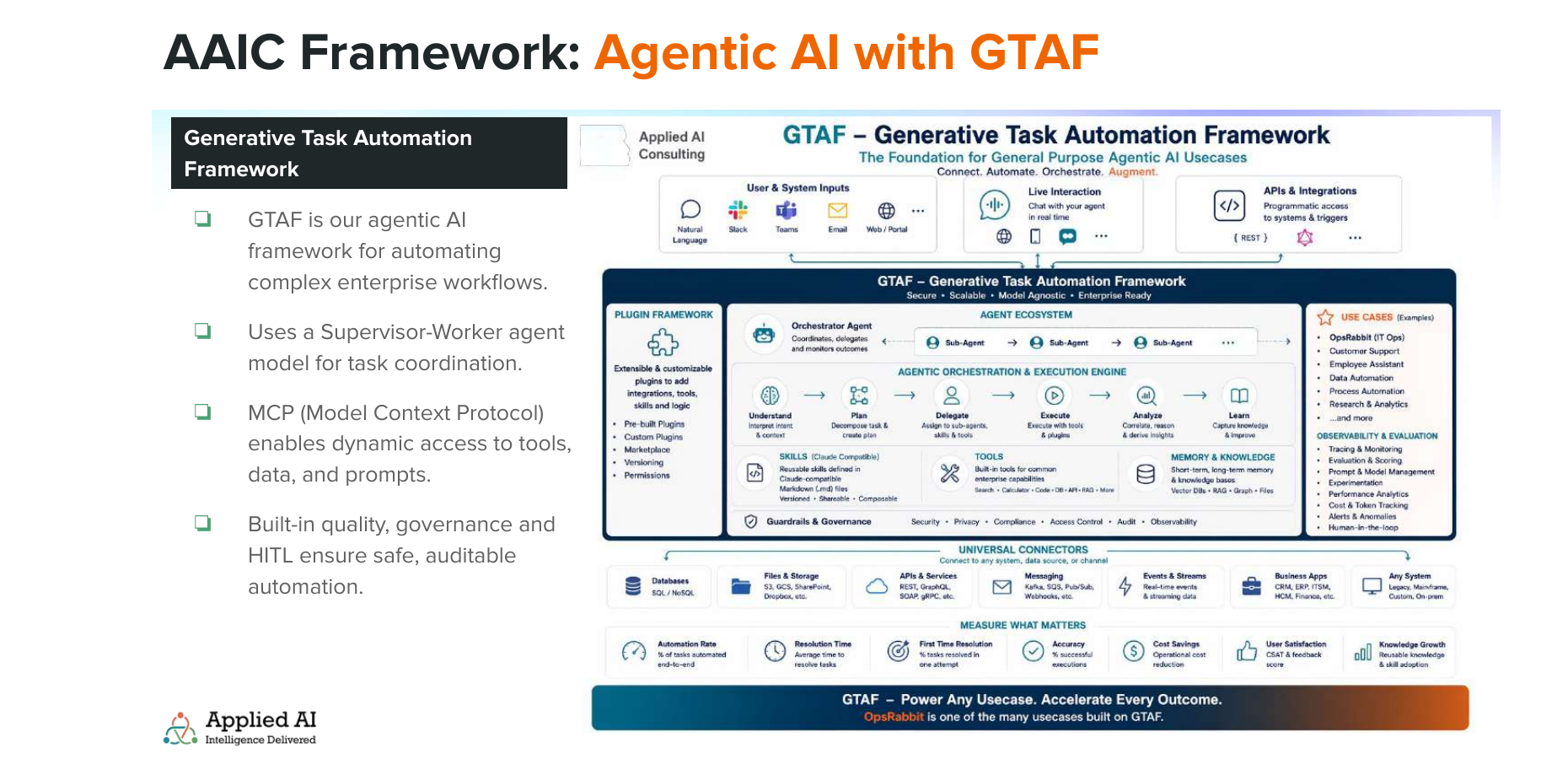
GTAF
Generative Task Automation Framework
GTAF is AAIC’s framework for automating complex enterprise workflows with coordinated agents, reusable workflow components, and production controls.
- Multi agent orchestration for task routing and coordination.
- MCP-enabled access to tools, data, prompts, and enterprise systems.
- Built-in quality, governance, and human-in-the-loop checkpoints for auditable automation.
OpsRabbit
AI incident investigation for ITOps, DevOps, and SRE
OpsRabbit investigates alerts, collects context in parallel, and recommends likely root cause and next steps for production operations teams.
- Targets alert investigation in about 2 minutes and up to 90% MTTR reduction.
- Connects with monitoring, ITSM, collaboration, cloud, and infrastructure tools.
- Supports agentless and on-prem deployment patterns for enterprise control.
Engagement model
A practical path from stuck prototype to production workflow.
Readiness assessment
Map the use case, stakeholders, systems, risks, and production constraints.
Production blueprint
Define architecture, integrations, controls, observability, testing, and delivery backlog.
Focused pilot
Build the workflow slice that proves production fit, not just model output quality.
Delivery pod
Scale with AI, cloud, DevOps, QA, and product engineering support.
FAQ
Questions engineering leaders usually ask first.
Who is this AI POC to production service for?
CTOs, engineering leaders, product engineering teams, CIOs, and IT leaders who have AI prototypes or workflow ideas but need help making them reliable, integrated, observable, and production-ready.
What usually blocks AI workflows from reaching production?
The model is rarely the only blocker. Teams often slow down around orchestration, enterprise integrations, governance, guardrails, observability, testing, deployment, and operational ownership.
What is production AI engineering?
Production AI engineering is the work required to make an AI workflow reliable inside real business systems. It includes orchestration, API and data integration, security controls, guardrails, testing, observability, deployment, and operational ownership.
How do you know if an AI POC is ready for production?
An AI POC is production-ready when the workflow has clear success criteria, approved data access, integration paths, fallback handling, quality checks, monitoring, cost visibility, security review, and a team responsible for operating it.
Can AAIC help if we already have models or vendors selected?
Yes. AAIC can work around existing models, cloud platforms, data sources, and vendor choices while focusing on the engineering layer needed to make workflows usable in production.
What does a first engagement look like?
A typical first step is a production readiness assessment or focused pilot that maps the workflow, integration points, risks, controls, deployment path, and effort required to move from POC to production.
Where do GTAF and OpsRabbit fit?
GTAF helps operationalize complex enterprise workflows with multi agent orchestration, MCP-enabled tool access, governance, and human-in-the-loop controls. OpsRabbit supports AI-driven incident investigation for ITOps, DevOps, and SRE teams by correlating alerts, logs, service context, and likely root cause.