Understand
Interpret the goal, user context, policy, and available evidence.
Agentic AI becomes valuable when it can move beyond answering a question and help complete a defined business workflow. That requires context, tools, state, validation, exception handling, and clear boundaries for human control.
Interpret the goal, user context, policy, and available evidence.
Break work into steps, select tools, route tasks, and define approvals.
Retrieve data, call approved APIs, update systems, and coordinate agents.
Validate results, preserve evidence, handle exceptions, and escalate safely.
Production agents need an orchestration and control layer around the model so every action is connected, observable, and accountable.
State, routing, retries, tools, and task coordination

Coordinate extraction, comparison, summarization, policy checks, human review, and downstream system updates.
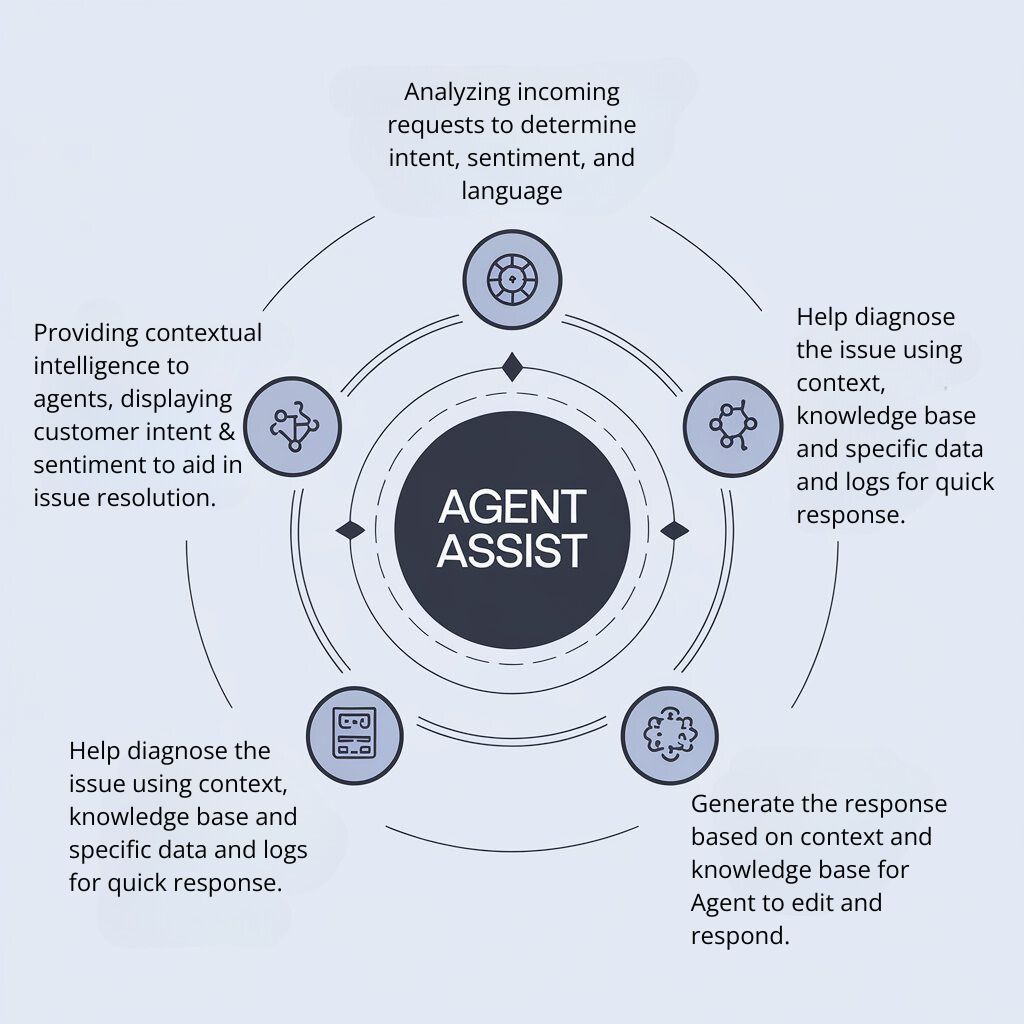
Retrieve account history, recommend next steps, draft responses, update records, and escalate exceptions.

Collect signals across systems, reconcile information, produce narratives, and route decisions to accountable owners.
GTAF is AAIC’s Generative Task Automation Framework for building and operating agentic workflows across enterprise systems. It provides reusable patterns for orchestration, tool integration, workflow state, human oversight, evaluation, and observability.
Start with reusable production patterns while keeping model, cloud, data, and tool choices aligned to enterprise requirements.
Explore GTAFRelated work
 Generative AI for Offer Rule Automation
AI-generated business logic integrated with validation and a usable workflow for financial services teams.
Explore Now
AI Agent Assist for Customer Support
Context, guided actions, summaries, and system records embedded in a real-time support workflow.
Explore Now
Generative AI for Offer Rule Automation
AI-generated business logic integrated with validation and a usable workflow for financial services teams.
Explore Now
AI Agent Assist for Customer Support
Context, guided actions, summaries, and system records embedded in a real-time support workflow.
Explore Now
 Automated Financial Document Processing
A controlled workflow for extraction, processing, storage, and review across financial documents.
Explore Now
Automated Financial Document Processing
A controlled workflow for extraction, processing, storage, and review across financial documents.
Explore NowAgentic AI uses software agents that interpret a goal, retrieve context, plan steps, use approved tools, coordinate actions, and involve people when judgment or approval is required.
A chatbot primarily exchanges messages. An agent can maintain workflow state, use tools and APIs, complete multi-step tasks, validate results, and trigger actions within defined controls.
Good candidates have clear goals, repeatable steps, accessible data, defined actions, measurable outcomes, and known exceptions.
We apply permissions, tool boundaries, human approvals, audit trails, evaluation datasets, output validation, exception handling, cost controls, observability, and release gates based on risk.
Yes. The architecture can use approved commercial or open models and connect to existing cloud, data, identity, business applications, and collaboration tools.